
The Real Story of Saint Patrick

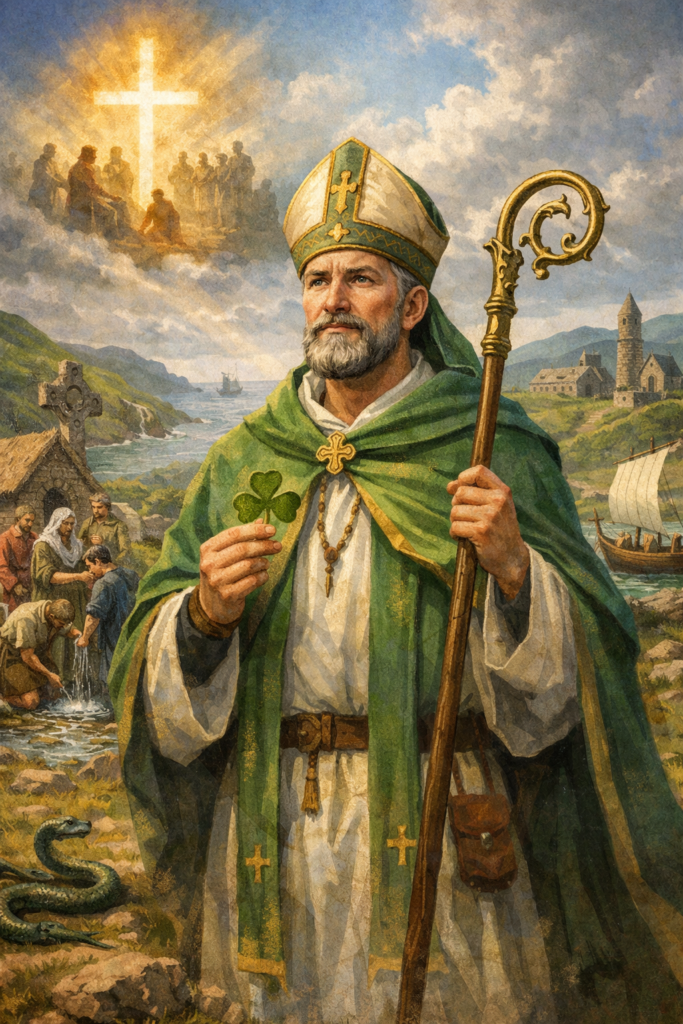
St. Patrick, the missionary who helped establish Christianity in Ireland during the 5th century.
The Real Story of Saint Patrick
Who was St. Patrick?
The real story of St. Patrick is very different from the legends surrounding St. Patrick’s Day. Patrick was not Irish, nor was he originally a missionary. Born in Roman Britain in the late 4th century, he was kidnapped by Irish raiders and enslaved in Ireland as a teenager. After escaping slavery and returning home, Patrick later returned to Ireland as a Christian missionary. His life of faith, forgiveness, and evangelism helped shape Christianity in Ireland and influenced the development of Celtic Christianity.
Every year on March 17, people around the world celebrate St. Patrick’s Day with parades, green clothing, leprechauns, and shamrocks. However, many people are not aware of the real story of St. Patrick or the true history of the man behind the holiday. Patrick’s life tells a powerful story of faith, forgiveness, and missionary courage.
Quick Facts About St. Patrick
- Born: Late 4th century in Roman Britain
- Kidnapped: Around age 16 by Irish raiders
- Enslaved in Ireland: Approximately 6 years
- Returned to Ireland: As a missionary in the early 5th century
- Known for: Evangelizing Ireland and helping establish Christian communities
- Death: March 17, traditionally dated around AD 461
Saint Patrick’s Early Life and Captivity in Ireland
Patrick was born in Britain in the late 4th century to a Christian family connected to the Roman world. However, as a teenager, his faith was not very important to him. Everything changed when he was about sixteen years old. Irish raiders attacked his village and captured him, carrying him across the sea to Ireland where he was sold into slavery.
For six years, Patrick worked as a shepherd in the rugged Irish countryside. During this difficult period of his life, he began to pray regularly and rediscovered the faith he had once ignored. In his own writings, Patrick later explained that his time in captivity led him to a deeper relationship with God, often praying up to 100 times a day.
How Saint Patrick Escaped Slavery and Became a Missionary
After several years of slavery, Patrick had a dream in which he believed God was guiding him to escape. He fled, traveled a great distance to the coast, and eventually found passage on a ship that carried him back to Britain.
Once home, Patrick began preparing for ministry. Years later, he experienced another powerful vision in which he heard the “voice of the Irish” calling him to return. Though Ireland had once been the place of his suffering, Patrick believed God was calling him back, this time as a missionary.
Saint Patrick’s Missionary Work in Ireland
Patrick eventually returned to Ireland as a Christian leader and missionary in the early fifth century, bringing with him a ministry team. Rather than imposing foreign customs on the non-Romanized Irish, he sought to understand the culture and communicate the Christian message in ways the Irish people could understand and relate to.
He traveled throughout the island preaching, baptizing new believers, and helping establish Christian communities. Some anecdotes suggest he baptized over 100,000 Irish people and planted more than 300 churches during his nearly thirty years of ministry in Ireland.
Patrick’s approach reflected what later writers have described as a relational model of evangelism. Instead of demanding immediate conversion, he built relationships, engaged local leaders, and demonstrated the Christian faith through his life and service. This approach helped Christianity take root in Ireland and grow throughout the island.
How Saint Patrick Influenced Celtic Christianity
Patrick’s ministry helped lay the foundation for what later became known as Celtic Christianity. In the centuries after his death, Ireland became a center of learning, monastic life, and missionary activity. Irish monks and scholars would eventually carry the Christian faith and classical learning across Europe during a time when much of the continent was struggling during the Dark Ages.
Because of this influence, Ireland earned the reputation as the “land of saints and scholars,” a phrase that reflects the lasting impact of St. Patrick’s mission.
The True Legacy of Saint Patrick
Patrick’s death on March 17 eventually became a day of remembrance and later a national holiday. Today, St. Patrick’s Day is often celebrated as a cultural festival, but the life of St. Patrick tells a much deeper story.
He was once a captive who returned to the land of his suffering with forgiveness in his heart and a message of hope. His life continues to remind Christians of the power of faith, perseverance, and mission. Behind the parades and shamrocks is the story of a man who believed the message of Christ was worth sharing, even with those who had once been his captors.
Common Questions About Saint Patrick
Was St. Patrick Irish?
No, St. Patrick was not originally Irish. He was born in Roman Britain in the late 4th century to a Christian family. As a teenager, he was kidnapped by Irish raiders and taken to Ireland as a slave. After escaping and returning home, he later chose to return to Ireland as a Christian missionary. Because of his decades of ministry there, he eventually became the most well-known figure in the history of Irish Christianity.
Did Saint Patrick Drive the Snakes Out of Ireland?
One of the most famous legends about St. Patrick claims that he drove snakes out of Ireland. However, historians and scientists agree that Ireland likely never had native snake populations after the last Ice Age. The story is widely believed to be symbolic, representing Patrick’s efforts to confront pagan practices and spread Christianity throughout the island.
Why Is Saint Patrick’s Day Celebrated on March 17?
March 17 is traditionally believed to be the date of St. Patrick’s death in the 5th century. Early Christians in Ireland observed the day as a feast day honoring his life and missionary work. Over time, the celebration spread around the world as Irish communities commemorated their heritage and the influence of Patrick’s ministry.
Further Reading
The Celtic Way of Evangelism (10th Anniversary Edition) by George Hunter
How the Irish Saved Civilization by Thomas Cahill
Lexie Dishroon, M.M. Ed.
Our mission is to accelerate the spread of the gospel across the beautiful island of Ireland by supporting and resourcing churches to reach the people of Ireland.
Hours
Mon – Fri:
9:00 am – 5:00 pm
Sat – Sun:
Closed